

Empty leg flights to and from Palma
Palma de Mallorca is the eleventh busiest business aviation airport in Europe and the busiest in the Balearics. In July 2026 it handled 2,088 private movements, an average of 67 a day and one flight in every fifteen that used the airport. A word on the name before anything else: Palma is the city and the airport, Mallorca is the island, and Majorca is how British airlines and tour operators still spell the island. Handlers and flight plans call the airport Palma de Mallorca.
The reason so many of those movements turn into empty legs is written into the aerodrome rules. Between June and September an aircraft longer than twenty metres may stand on the general aviation apron for seven days and no longer, stands are scarce for the whole summer, and Spanish airport charges went up again in 2026 with parking rising fastest of all. Aircraft drop their passengers and go.
Empty legs to and from Palma right now
Every sector our operator network has released into or out of Palma appears on the board below. When Mallorca itself is quiet, the board adds flights at Ibiza, Menorca, Valencia and Barcelona instead, because half an hour or so in the air links any of the Balearics with any other and with the nearest mainland airports.
| Date | From | To | Aircraft | Passengers | Price | |
|---|---|---|---|---|---|---|
| 21 Dec 2026 | Palma de Mallorca, ES (PMI/LEPA) | London Luton, GB (LTN/EGGW) | Citation Latitude | 9 | 7,800 GBP | Request |
| 1 Sep 2027 | Palma de Mallorca, ES (PMI/LEPA) | Teruel, ES (TEV/LETL) | Citation Latitude | 9 | 4,400 GBP | Request |
Prices are for the whole aircraft and are shown in pounds. Some are indicative figures worked out from the distance and the class of jet; the firm price is confirmed with the operator when you send a request.
Also moving across the rest of the Balearics and the Spanish mainland
Sectors on this list do not touch Palma itself. They are shown because the fields are close enough that the drive rarely costs you more than waiting for the right sector does. Tell us which one interests you and we will confirm it is still open.
| Date | From | To | Aircraft | Passengers | Price | |
|---|---|---|---|---|---|---|
| 2 Nov 2026 | Bristol International, GB (BRS/EGGD) | Ibiza, ES (IBZ/LEIB) | Bombardier Global 6000 | 12 | 14,300 GBP | Request |
| 18 Nov 2026 | London Luton, GB (LTN/EGGW) | Josep Tarradellas Barcelona-El Prat, ES (BCN/LEBL) | Hawker 400XP | 7 | 12,384 GBP | Request |
Prices are for the whole aircraft and are shown in pounds. Some are indicative figures worked out from the distance and the class of jet; the firm price is confirmed with the operator when you send a request.
Typical empty leg prices between the UK and Palma
Guide prices for the whole aircraft, in pounds, on the corridors that produce repositioning sectors most often. These are not live offers and carry no dates: what is available right now is in the schedule on this page. The charter column is the same aircraft booked on your own dates.
| Route | Aircraft | Seats | Flight time | Empty leg from | Charter from |
|---|---|---|---|---|---|
| Jersey to Palma | Citation XLS+ | 8 | 2h 00m | 6,300 GBP | 15,100 GBP |
| Palma to Guernsey | Citation XLS+ | 8 | 2h 05m | 6,600 GBP | 15,700 GBP |
| Palma to Southampton | Citation XLS+ | 8 | 2h 10m | 6,800 GBP | 16,300 GBP |
| London to Palma | Citation XLS+ | 8 | 2h 20m | 7,400 GBP | 17,600 GBP |
| Palma to Oxford | Citation XLS+ | 8 | 2h 20m | 7,400 GBP | 17,600 GBP |
| Bristol to Palma | Citation XLS+ | 8 | 2h 20m | 7,400 GBP | 17,600 GBP |
| Palma to Cardiff | Citation XLS+ | 8 | 2h 25m | 7,600 GBP | 18,200 GBP |
| Birmingham to Palma | Citation XLS+ | 8 | 2h 30m | 7,900 GBP | 18,900 GBP |
| Palma to Manchester | Citation XLS+ | 8 | 2h 35m | 8,200 GBP | 19,500 GBP |
| Liverpool to Palma | Citation XLS+ | 8 | 2h 35m | 8,200 GBP | 19,500 GBP |
| Palma to Leeds | Citation XLS+ | 8 | 2h 40m | 8,400 GBP | 20,100 GBP |
| Dublin to Palma | Citation XLS+ | 8 | 2h 40m | 8,400 GBP | 20,100 GBP |
| Palma to Belfast | Citation XLS+ | 8 | 2h 45m | 8,700 GBP | 20,700 GBP |
| Isle of Man to Palma | Citation XLS+ | 8 | 2h 45m | 8,700 GBP | 20,700 GBP |
| Palma to Edinburgh | Citation XLS+ | 8 | 2h 50m | 9,000 GBP | 21,400 GBP |
| Newcastle to Palma | Citation XLS+ | 8 | 2h 50m | 9,000 GBP | 21,400 GBP |
| Palma to Glasgow | Citation XLS+ | 8 | 2h 55m | 9,200 GBP | 22,000 GBP |
| Aberdeen to Palma | Citation XLS+ | 8 | 3h 05m | 9,700 GBP | 23,200 GBP |
Both columns assume an aircraft already at the departure airport, so no positioning flight is billed. Where an operator has to fly one in to collect you, a charter can run considerably higher than the figure shown. Prices also run in both directions: an empty leg exists only when an operator is moving that aircraft anyway, so the sector you want may run the other way this month. Tell us the route and we will watch both directions for you.
Most empty legs are gone within hours of being released, and a good number are never published at all. Tell us the route and the window you can travel in, and we will message you the moment a matching sector comes up between the UK and Palma.
Nothing is stored on this site. The button opens a chat with the message already written, and you send it yourself. We reply during office hours, 07:00 to 23:00, and check messages outside them too.
Where Palma sectors come from
Three mechanisms push aircraft away from Mallorca with the cabin empty, and all three run hardest in exactly the months you want to fly.
The aircraft themselves tell you what to expect on the board. Mallorca is a light and midsize market rather than a heavy one: the workhorses on the British routes are the Citation XLS and its stablemates, the Phenom 300 and the smaller Citations, and a heavy jet on a Palma sector is the exception. That is why a crossing from Britain usually seats six to eight rather than twelve, and why the discount on a Balearic empty leg tends to run deeper than on the long routes, where the aircraft is expensive enough that the operator will wait for a paying charter.
Palma de Mallorca Airport in detail
Son Sant Joan is a large commercial airport with a general aviation operation tucked into one corner of it, on an apron of its own.
| Codes and name | PMI (IATA), LEPA (ICAO). The airport is named Son Sant Joan after the land it stands on, and is signed as Aeropuerto de Palma de Mallorca. Both names appear in flight plans and handling paperwork |
| Location | Eight kilometres east of Palma. Reference point 39 33 06 north, 002 44 20 east. Elevation 8 metres, or 27 feet, which is as close to sea level as a major airport gets. Operated by Aena |
| Runways | Two parallel asphalt runways. 06L/24R is 3,270 by 45 metres and 06R/24L is 3,000 by 45 metres. When the wind allows, arrivals use 24L and departures 24R. 24L is equipped for low visibility landings, so fog is rarely the thing that stops a flight |
| Hours | The airport is open 24 hours, and so are air traffic services, refuelling, customs and passport control. There is no curfew of any kind and no ban on business aviation at night. What the night hours bring are noise rules that fall on everyone: no training flights, no engine run ups, no reverse thrust above idle and limits on running an auxiliary power unit at the stand. Night for those purposes is 2100 to 0500 or 2200 to 0600 UTC by season, which works out at 2300 to 0700 local in both. Residents groups campaigned in 2025 for a ban on movements between 2300 and 0600 and are still protesting about aircraft noise, but nothing of the kind has been adopted |
| Slots | From 1 April to 30 September every general aviation and corporate aviation flight must submit slot data for both the arrival and the departure, together with the registration, the aircraft type and its length and wingspan. Outside those six months the requirement lifts, which is one of several reasons a winter sector is easier to arrange than a July one. Coordination for slots and stands opens roughly fourteen days before the flight, so an answer earlier than that is a forecast rather than a confirmation |
| Parking | General aviation uses the stands in the 200 to 247 series. From 1 June to 30 September an aircraft over twenty metres in length may not stay on that apron for more than seven days unless the airport expressly authorises it. Note that the rule is written on length rather than wingspan, which is unusual and means it is the longer cabins rather than the wider wings that are caught. In peak weeks overnight parking is refused often enough that handlers plan around it, and hangarage is limited and arranged only through a handler |
| Handling | A handling agent is compulsory. The published rules state it plainly: every general and business aviation operation must contract one. The handler files the slot, books the stand, meets the aircraft and takes the paperwork to customs, so it is the first call rather than a convenience |
| Customs and border control | Palma is a full airport of entry with customs and the national police on site around the clock. A flight from Britain crosses the external Schengen border, so passports are checked and a general declaration is filed for the aircraft |
| Ground movement | Palma is one of the European airports running collaborative decision making in full, which means the departure time filed by the handler has to match the slot the airport issues. A mismatch is not waved through and can cost real time on the ground, so the times you give the handler need to be the times you mean |
| Traffic | There were 2,088 business aviation movements in July 2026 alone, 6.5 per cent of the 32,198 flights the airport handled that month. Across June and July the count was 4,020 against 4,181 a year earlier, and the second half of August ran 7.4 per cent ahead of 2025, leaving the summer as a whole about 1 per cent down. Aena publishes no business aviation split of its own, so these figures come from flight tracking data rather than from the airport. In commercial terms Palma is the third largest airport in Spain, with 33,806,427 passengers and 246,486 movements in 2025 |
| Work in progress | Aena is finishing a remodelling of the passenger terminal worth around 560 million euros, begun in 2022 and due to complete at the end of 2026. Nothing in it touches the general aviation side, which is the good news; the less good news is that it has been reorganising the forecourt, the taxi ranks and the car parks in front of the main terminal, which matters if somebody is meeting you on the public side |
Two of those lines do most of the work. The compulsory handler explains why a Palma flight cannot be arranged quite as casually as a domestic British one, and the fourteen day coordination window explains why in June an August stand can only be called possible, not booked. Two more points are worth knowing: Palma has no night curfew, and outside the April to September window a private flight does not need a slot at all.
The general aviation terminal and its handlers
Private flights use a terminal of their own, on its own apron with a separate road entrance, well away from the commercial modules and their thirty three million passengers. The aerodrome rules name two sets of companies. Two are authorised by the airport as general and business aviation managers, which is what lets a passenger enter through the general aviation terminal at all. Seven, including those two, are approved as ramp agents and may look after the aircraft itself. Which of them meets you is settled by your operator rather than by you, so it is worth knowing who is who.
You do not choose the handler, but you can ask which one the operator uses before you book, and the answer tells you which door your car will stop at and whose lounge you will wait in. They all work out of the same building, so the difference is in the room and the service rather than in the distance to the aircraft.
The terminal from a passenger's side
What actually happens between the car and the seat, in the order it happens, for a British passenger arriving at Palma or leaving it.
The one thing worth planning around is food. A commercial passenger expects to eat at the airport; a private passenger at Palma should either eat before leaving the villa or tell the handler a day ahead what to put on board.
Four rules that shape a Mallorca trip
None of this makes Mallorca difficult. Handlers deal with it daily and the island takes more private traffic than anywhere else in the Balearics. It does mean that a Palma trip planned three weeks ahead goes more smoothly than one planned three days ahead, and that the aircraft leaving without you is the normal outcome rather than a sign that something went wrong.

What the ground costs on Mallorca
Spain charges no passenger tax on private flights, which makes the arithmetic here simpler than in Italy or France. What you do pay falls into three groups, and only the first appears on the charter invoice.
The tourist tax is the one visitors ask about, and it is smaller than the coverage suggests. In high season, which runs from 1 May to 31 October, it is 4 euros a person a night at a five star or four star superior hotel, 3 euros at a four star or three star superior, 2 euros at everything from a one to three star hotel up through tourist apartments, rural hotels and registered holiday rentals, and 1 euro in a guest house or a campsite, with ten per cent of Spanish VAT added on top. Children under sixteen pay nothing and the rate halves from the ninth night. From 1 November to 30 April it drops to roughly a quarter of those figures rather than disappearing.
Much was made of a rise in those rates for 2026, taking the top band to 6 euros and adding a summer surcharge. It did not happen: the increase was shelved for want of votes in the Balearic parliament and the rates above are the ones in force. In September 2026 the Balearic government also ruled out a rise in its budget for 2027, but the subject keeps returning, so confirm the figure with the hotel when you book rather than trusting a number from a news story.
Hire cars are the other recurring question. Nothing limits them at present: there is no cap on vehicles entering Mallorca in 2026 and no access charge to pay. A bill to introduce both, together with a ceiling on the number of hire cars, began its passage through the Balearic parliament on 9 September 2026, with a traffic study due in October and the government aiming at the summer of 2027, so the position may well be different next year.
Son Bonet, Menorca and the fields worth knowing
Mallorca has one airport that takes jets and one that does not, and the neighbouring islands matter more here than they would on the mainland.
From the terminal to the villa, the port or the mountains
Palma is the best placed airport in the Balearics: nothing on Mallorca is more than about ninety minutes away, and most of the places people actually go are under forty five. The times below are estimates for a car outside the peak. In July and August the Ma-1 and the Ma-19 can add twenty to thirty minutes to any of them, which is the single best argument for the helicopter.
| Destination | By road | Notes |
|---|---|---|
| Palma old town and Son Vida | 15 to 25 minutes | The closest, and the reason a morning meeting on the island is realistic |
| Puerto Portals and Bendinat | 25 to 40 minutes | The marina set, and the shortest run to a berth |
| Port Adriano and Santa Ponsa | 30 to 45 minutes | South west coast, superyacht berths at Port Adriano |
| Andratx and Port d'Andratx | 40 to 65 minutes | The far south west, quieter and more residential |
| Valldemossa and Deia | 45 to 70 minutes | Into the Tramuntana, slow road and worth every minute of it |
| Soller and Port de Soller | 40 to 55 minutes | Through the tunnel, or over the pass if nobody is in a hurry |
| Alcudia and Pollenca | 55 to 80 minutes | The north coast, the longest regular transfer on the island |
| Cala d'Or and Santanyi | 45 to 60 minutes | The east coast, and the transfer most often flown by helicopter instead |
The handler will have the car waiting at the terminal door, and because the general aviation building has its own entrance you avoid the commercial forecourt, which in August is worth more than the ten minutes it saves. For the north coast and the east, a helicopter out of Son Bonet turns the longest transfers into a quarter of an hour, in daylight only.
Popular routes between the UK and Palma, and which way they run empty
Each figure is a guide for one empty leg, with all eight seats of a Citation XLS+ included. The charter price for the same aircraft is a little under two and a half times as much, and both numbers sit in the live table above when a real sector is on the board.
| Route | In the air | Empty leg from | Season | Which way it usually runs empty |
|---|---|---|---|---|
| Jersey to Palma | 2h 00m | 6,300 GBP | May to September | Out empty to collect, most often at the weekend |
| Palma to Guernsey | 2h 05m | 6,600 GBP | May to September | Home to Guernsey after a drop on the island |
| Palma to Southampton | 2h 10m | 6,800 GBP | April to October | Home to the south coast after a drop |
| London to Palma | 2h 20m | 7,400 GBP | All year | Both directions, and the busiest corridor of all |
| Palma to Oxford | 2h 20m | 7,400 GBP | April to October | Home to Oxford after a drop |
| Bristol to Palma | 2h 20m | 7,400 GBP | May to September | Out empty to collect a party |
| Palma to Cardiff | 2h 25m | 7,600 GBP | May to September | Back to Cardiff the same evening |
| Birmingham to Palma | 2h 30m | 7,900 GBP | May to September | Out empty to collect, weekends mostly |
| Palma to Manchester | 2h 35m | 8,200 GBP | April to October | Home to Manchester after a drop |
| Liverpool to Palma | 2h 35m | 8,200 GBP | May to September | Out empty to collect |
| Palma to Leeds | 2h 40m | 8,400 GBP | May to September | Home to Leeds Bradford after a drop |
| Dublin to Palma | 2h 40m | 8,400 GBP | May to September | Both, and steadier than the British routes in shoulder season |
| Palma to Belfast | 2h 45m | 8,700 GBP | June to September | Occasional, so registering is the way to catch one |
| Isle of Man to Palma | 2h 45m | 8,700 GBP | June to September | A handful each summer, in both directions |
| Palma to Edinburgh | 2h 50m | 9,000 GBP | May to September | Home to Edinburgh after a drop |
| Newcastle to Palma | 2h 50m | 9,000 GBP | June to September | Out empty to collect |
| Palma to Glasgow | 2h 55m | 9,200 GBP | May to September | Home to Glasgow after a drop |
| Aberdeen to Palma | 3h 05m | 9,700 GBP | June to September | Occasional in both directions |
Friday and Saturday afternoons are when the outbound sectors appear and Sunday evenings when the return ones do, which is the opposite of the business corridors into Milan or Geneva. A party flown out on Friday leaves an aircraft with nothing to do until Sunday, and rather than pay two days of Balearic parking the operator takes it home or to the mainland and sells the crossing to whoever wants it.

Online calculator
If you want to see what your route would cost as a standard charter, so you have something to measure an empty leg against, use the calculator below. Fill in the airports, the dates and the number of passengers, add any preference on aircraft type, and we will send a written calculation by email or messenger. Please check your contact details carefully so that we can reply quickly.
The figure the calculator returns is an estimate for planning. The firm quote comes back from our consultants with the cost broken out line by line, and the price agreed there is the price written into the contract.
If you would rather skip the arithmetic, send us the route and the dates instead and a consultant will come back with both numbers, the charter price and any empty leg that fits.
Arriving in Palma from the UK
The Balearics are Spanish, Spain is in the EU and in Schengen, and Britain is in neither, so the border is checked properly in both directions even at a private terminal.
- Passport. It must be less than ten years old on the day you land in Spain and still valid three months beyond the day you intend to leave. Ninety days in any 180 is the ceiling across the whole Schengen area, not per country.
- The Entry/Exit System. A first crossing means a facial image and, for adults and older children, fingerprints. The system became fully operational across every Schengen external border on 10 April 2026, and Spanish airports no longer stamp passports at all; the record is digital.
- ETIAS. Still to come. In July 2026 the launch was put back to 2027; the authorisation will cost 20 euros for travellers aged 18 to 70 and stay valid for three years or until the passport runs out, whichever arrives first.
- Customs coming in. The duty free allowance per adult runs to 200 cigarettes, one litre of spirits, four litres of still wine, sixteen litres of beer and 430 euros of everything else. Cash from ten thousand euros upwards is declarable. Meat and dairy brought from Britain are refused at the border whatever the quantity.
- Bags. The Guardia Civil may open luggage on the way in or out, and the private terminal is not exempt from that.
- Going home. Britain allows 4 litres of spirits, 18 litres of still wine and 42 litres of beer per adult on a private arrival, with a further 270 GBP of goods, but nothing made of meat or milk. Cava bought on the island will count as wine, and cider as beer, once the British categories change on 1 October 2026. Those figures are for Great Britain: the Northern Irish, Jersey and Guernsey allowances differ. Travellers on passports other than British or Irish ones should confirm whether they now need a UK electronic travel authorisation.
- Taxes. Air Passenger Duty leaving Britain, nothing at all leaving Spain, and the Balearic tourism tax on the accommodation.
Empty leg calendar for Palma, month by month
Mallorca has a real season, unlike Milan or Geneva, so its months differ sharply in how many aircraft the island draws and in what that leaves for buyers of empty legs.
What the island is doing to the market that month: the pull on aircraft, and the knock on effect on charter prices, slots and stands.
What lands on our board: the number of British sectors released that month and how deep the discount on them runs.
May and September are the months to aim for. Both have a full market without the August premium, and September has the additional advantage that the parking ceiling and the slot requirement both end with the month, so a stay that runs on into October meets a relaxed airport and still warm weather.
Fly private, your way
Tell us your route - we'll respond within the hour.
Three situations, three answers
Flying to Palma with a dog or a cat
An animal leaving Britain for Spain needs three things: a microchip, a rabies vaccination given no less than 21 days before departure, and an animal health certificate signed by an official vet within ten days of the flight. An EU pet passport issued to a British resident before 22 April 2026 may no longer be accepted for entry, so the certificate is the document to rely on. It is good for ten days to enter the EU, then for four months of onward travel inside it and four months of re-entry to Great Britain. There is a second thing to check before booking, which is the breed. Spanish law puts eight of them on a potentially dangerous list, and a dog on that list has to be muzzled anywhere in public and held on a non extendable lead under two metres, one dog to a handler: the pit bull terrier, the Rottweiler, the Staffordshire bull terrier, the American Staffordshire terrier, the Dogo Argentino, the Fila Brasileiro, the Tosa Inu and the Akita Inu. Regions and town halls add licence and insurance requirements of their own.
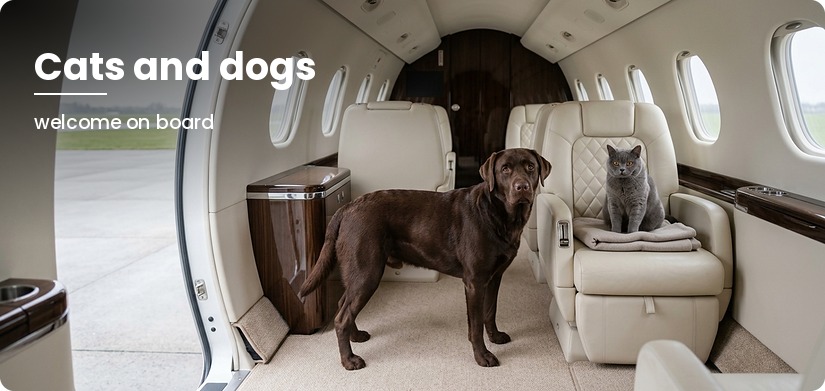
The journey back is the part that needs arranging first. Two conditions govern it: Great Britain takes pets by private jet only from an operator approved for that particular route, and not every operator is; and a dog needs a tapeworm treatment from a vet no more than 120 hours and no less than 24 hours before landing. Palma has vets who do this work constantly, but in July and August their appointments fill weeks ahead, so book the vet when you book the flight. Mention the dog or the cat when you write to us the first time, and the sectors whose operators refuse animals never reach your shortlist.
Questions about flying private to Palma
Call +44 7857 574938 , message the same number on WhatsApp , or write to flight@empty-leg.co.uk . Tell us the airports, the dates, how many are travelling and how much the dates can move, and we will come back with the sectors that fit and the charter price beside them.
The aviation expert will answer all your questions about business aviation and private flights. We will help you to compare and choose the best business jet for your flight.