Free consultation on private flights
Most people who contact us are not ready to book. They want to know whether a private flight makes sense for their trip at all, what it would realistically cost, and whether an empty leg is worth waiting for. We answer those questions for free, we do not put you on a list afterwards, and we will tell you when the answer is that you should fly with an airline instead.
Our consultants deal with operator schedulers every day and arrange flights out of every business aviation field in Britain. That is the knowledge we are offering here, whether or not it ends in a booking.
What we can help you work out
- Whether an empty leg exists on your route. Some corridors produce them weekly, others once a month. We will tell you which yours is before you start waiting.
- What your trip would actually cost. A written calculation with the aircraft, the tax and our fee broken out, rather than a single figure with no working shown.
- Which aircraft class fits. Group size, baggage, range and the runway at the far end. This is where most quotes go wrong before anyone has looked at a price.
- Which airport to use. Farnborough, Luton, Biggin Hill, Northolt, London City and Stansted behave very differently on slots, hours and cost.
- What the paperwork involves. Passenger details for the border, documents for your accounts, and what an operator's contract will and will not cover.
- How to travel with a dog. The rules on bringing an animal into the UK by general aviation catch people out more than any other single thing.
The aviation expert will answer all your questions about business aviation and private flights. We will help you to compare and choose the best business jet for your flight.
Call +44 7857 574938, message the same number on WhatsApp, or write to flight@empty-leg.co.uk. The office is open 07:00 to 23:00 seven days a week and messages are read outside those hours. You are also welcome to come to us at Signature FBO, Terminal 1, London Luton Airport, by arrangement.
Empty legs, answered
These are the questions that come up in almost every first conversation about repositioning sectors. Open the ones that apply to you.
-
- What exactly is an empty leg?
-
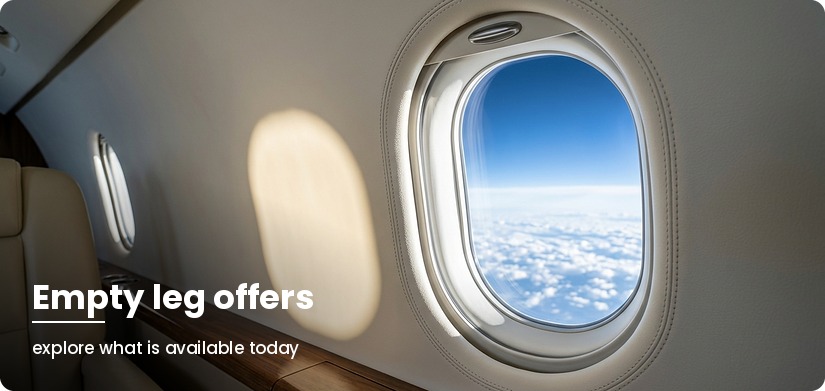
A sector an aircraft is flying without passengers: going home after a one way charter, moving to collect its next client, or transferring between operator bases. The fuel, the crew and the handling are already committed, so the operator would rather sell the sector than fly it empty.
Around 40 per cent of business jet movements are of this kind, which is why there is a market in them at all.
-
- How much do they actually save?
-
Between 25 and 75 per cent against the same aircraft booked as a standard one way charter. The wide range is honest: it depends on the class of aircraft, how close the departure is and how much pressure the operator is under to fill that particular sector.
Ask us for the standard charter price alongside the empty leg price. Comparing the two on the same aircraft and the same day is the only meaningful way to judge whether a sector is good value.
-
- Is the aircraft or the service any worse?
-
No. Same aircraft, same crew, same maintenance standard, same cabin. The operator is recovering cost on a flight it had already committed to, not running a cheaper version of it.
The differences are entirely in the schedule: fixed airports, a fixed departure, one direction, and a small risk that the sector is withdrawn.
-
- Can I choose the date and the time?
-
Not really. The airports and the departure are set by the operator's own schedule. A shift of two or three hours can sometimes be negotiated if the aircraft's next commitment allows it, but that is a request rather than a right.
If your date is fixed, a standard charter is the honest answer and we will quote it for you.
-
- How often is a sector withdrawn?
-
Rarely, but it happens, and you should know it before booking. An empty leg exists because of another charter. If that charter moves or falls away, the sector goes with it. Industry estimates put this at roughly one sector in ten.
If it happens you are refunded in full, we tell you the moment the operator tells us, and we come back the same day with alternatives. It is also why we would not put an unmissable arrival on an empty leg.
-
- When should I be looking?
-
Most sectors surface one to two weeks before departure. The deepest prices appear inside the last 24 to 72 hours, and so does the smallest choice.
Registering your route with us works better than refreshing a page, because a good sector on a popular corridor is usually gone the same day it appears.
-
- Can I book an empty leg in both directions?
-
A single empty leg is always one way, because the aircraft is repositioning to a specific place for its own reasons. Two sectors covering an outbound and a return within the same window are possible and we arrange them regularly, but they will usually be different aircraft.
Where no matching return exists, the common solution is an empty leg one way and a standard charter the other, which still removes a large part of the cost.
What a flight costs, in numbers
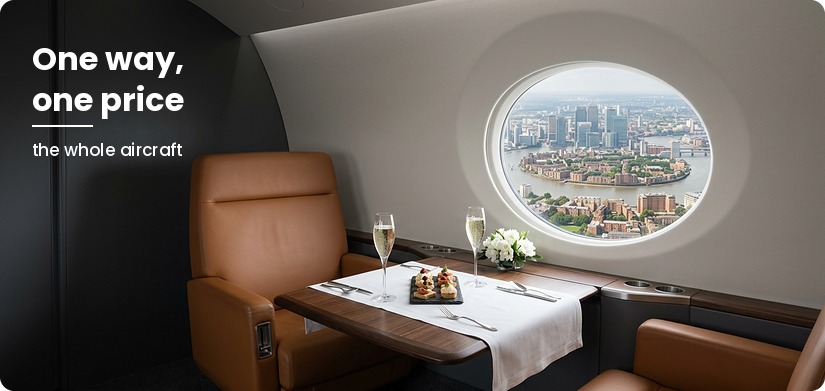
Two taxes and one rule explain most of the confusion about private jet pricing in Britain. Everything is priced for the whole aircraft rather than per seat, so the same figure carries one passenger or eight.
Air Passenger Duty, charged per passenger on UK departures
| Destination band | From April 2026 | From April 2027 |
|---|---|---|
| Domestic and band A, within 2,000 miles of London | 142 GBP | 146.63 GBP |
| Band B | 1,097 GBP | 1,132.76 GBP |
| Band C | 1,141 GBP | 1,178.20 GBP |
From April 2027 the higher rate above applies to every business aircraft of 5.7 tonnes or more, which brings almost the whole midsize fleet into scope.
VAT, which works backwards from what people expect
A flight from the UK to anywhere outside it is zero rated. Luton to Nice, Geneva or New York carries no VAT at all.
A domestic sector is zero rated only if the aircraft is designed to carry ten passengers or more. London to Edinburgh on a six seat light jet is therefore standard rated at 20 per cent, while the same route on a larger aircraft is not.
What sits inside the price
Fuel
Handling at both ends
Landing and navigation charges
Standard catering
Baggage within the aircraft's limits
VAT where a domestic sector attracts it
De-icing in winter, at cost
Extended parking if the aircraft waits
Special catering and ground transport
Our brokerage fee
One question we are asked constantly: why do two quotes on the same route differ by thousands? Almost always because of where the aircraft starts. One already parked at Luton costs far less than an identical jet flying in empty from Geneva to collect you, and that positioning sector is billed to you.
Choosing the aircraft
Group size and baggage usually decide the class before range does. This is the shape of the market from British airports.
| Class | Seats | Where it works from the UK | Baggage in practice |
|---|---|---|---|
| Turboprop King Air 350, PC-12 |
6 to 9 | Domestic hops, Channel Islands, Ireland | Generous for its size, takes short strips |
| Light jet Citation CJ3, Phenom 300 |
5 to 8 | Paris, Edinburgh, Dublin, Amsterdam | Roughly one case per passenger, skis are tight |
| Midsize Citation XLS+, Hawker 900XP |
7 to 9 | Nice, Geneva, Milan, Palma without a fuel stop | Comfortable for a week away, golf usually fine |
| Heavy Legacy 650, Falcon 900 |
10 to 14 | Larger groups, Middle East, North Africa | Rarely a constraint |
| Ultra long range Global 6000, G650 |
12 to 16 | The Gulf and the transatlantic | Rarely a constraint |
A light jet hold is smaller than most people expect. Six sets of golf clubs will not fit in a Citation CJ2 however many seats are free, and skis need agreeing in advance rather than assuming. Tell us what you are carrying and we will check it against that specific aircraft.
Which UK airport
In Britain the London fields are not interchangeable, and the right one often saves more time than the aircraft does.
| Airport | Best for | Watch out for |
|---|---|---|
| Farnborough | Business aviation only, anyone west or south of London | About forty minutes from the centre on a good run |
| Luton | The busiest and best supplied, three handling agents | No landings between roughly 23:00 and 06:00 |
| Biggin Hill | South east London, helicopter shuttle to the centre | Runway suits up to larger midsize types |
| Northolt | Closest to Mayfair and Kensington | Daily movement cap, availability decides not price |
| London City | The City and Canary Wharf | Smaller types only, crews need specific certification |
| Stansted | Late arrivals, open around the clock | Slots required, further out than the others |
Outside London, Manchester, Birmingham, Edinburgh, Glasgow, Bristol, Aberdeen, Leeds Bradford, Cardiff and Jersey all handle business aviation. Landing and handling there are usually cheaper than at a dedicated London field. What costs more is availability, because fewer aircraft are based nearby.
On board and on the day
Short answers to the things people ask once they have decided to fly.
How early do I arrive?
Fifteen to twenty minutes at a business aviation terminal for a domestic sector, twenty to thirty for an international departure. Passport control applies at private terminals too, it is simply far quicker.
Can I smoke on board?
It is legal, but it depends entirely on the aircraft owner. Ask at the enquiry stage and we will look specifically for an aircraft that permits it, because it cannot be arranged on the day.
Is there wifi?
On many aircraft but not all, and coverage over water can be patchy. If you need to work in the air, tell us and we will treat connectivity as a requirement rather than a bonus.
What catering comes as standard?
A cold selection appropriate to the time of day and the length of the flight. Anything beyond that, including hot food or an order from a named restaurant, is arranged in advance and quoted separately.
Is there a cabin attendant?
Standard on heavy and ultra long range aircraft, optional on many midsize types and rarely available on light jets. Say if it matters and we will filter on it.
Is there a dress code?
None. Wear what you like.
Can I bring my dog?
Yes, in the cabin at your feet. The constraint is the airport: animals may only enter the UK by general aviation through approved points of entry, and not every field that takes your aircraft will take your dog. A microchip, valid rabies vaccination and the correct health certificate are required.
What about customs at small airfields?
Officers know a private flight is coming and attend the terminal for it. On a quiet field the whole process can take a couple of minutes.
Booking, changing and cancelling
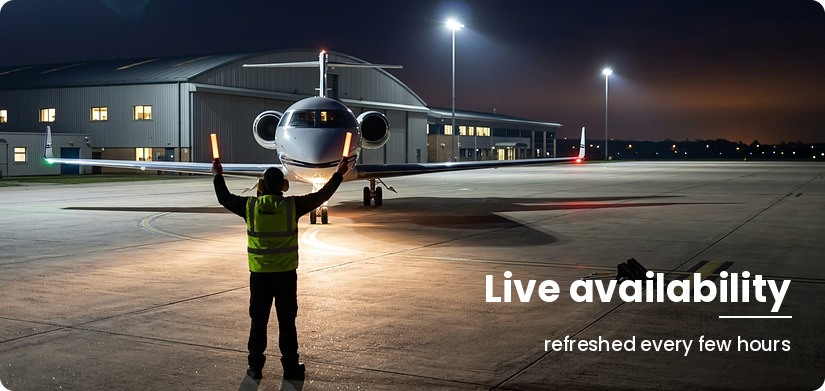
- Send the request. Route, dates, passenger numbers and anything unusual. Three to four hours from enquiry to departure is realistic when an aircraft and a slot are free, so call rather than write if you are flying today.
- Compare the options. We come back with three to five aircraft at different price points, with any empty leg shown alongside the standard charter price for the same route.
- Sign and pay. The contract names the operator and the aircraft and sets out the cancellation terms in full. Payment is in sterling, in full, before departure.
- Receive the flight brief. Aircraft and registration, route and timings, crew contact, the FBO address and the handling agent at both ends.
Ask someone directly
If you would rather put a question to a particular person, our consultants are below with their direct addresses. Anything technical about aircraft or operators is best sent to the aviation department, anything about invoices and contracts to the commercial side.

Charlotte Mckinney
Commercial Director

Henry Richter
Head of Aviation

Emma Miller
Director of Development

Liam Bishop
Leading Aviation Consultant

Oliver Davis
Air Broker

Anna Laurent
Aviation Consultant
Phone and WhatsApp: +44 7857 574938
Email: flight@empty-leg.co.uk
Hours: 07:00 to 23:00 daily, enquiries answered around the clock
We also have an office in Limassol, Cyprus. Full addresses and maps for both are on the contacts page.