Empty leg flights to and from Zurich
Zurich is usually counted among the six busiest business aviation airports in Europe, with around twenty six thousand private and corporate movements a year, and it works hard in every season. On a weekday the traffic is banking, insurance and the head offices around the lake; from December to April it is skiers heading for St Moritz, Davos, Klosters and Laax; and for one week in January it is the World Economic Forum, when a thousand extra flights pass through a single airport.
What turns that traffic into empty legs is that Zurich is full. Every instrument flight needs an airport slot, the evening ends early for business aircraft, and parking for them is scarce, scarcer still whenever something big is on. An aircraft that has delivered its passengers rarely has anywhere to wait, so it leaves, and the flight out is one you can buy.
Empty legs to and from Zurich right now
The board below lists every sector our operator network has released into or out of Zurich. If Zurich is quiet, the board adds flights at Basel, Bern, St Gallen, Samedan, Friedrichshafen and, in Forum week, Dübendorf instead, because each of them is a drive or a short hop away and all of them take the traffic Zurich cannot.
| Date | From | To | Aircraft | Passengers | Price | |
|---|---|---|---|---|---|---|
| 27 Oct 2026 | London (EGGW) | Zurich (LSZH) | Hawker 750 | 8 | 5,300 GBP | Request |
| 9 Nov 2026 | Birmingham International, GB (BHX/EGBB) | Zurich, CH (ZRH/LSZH) | Phenom 100 | 4 | 2,400 GBP | Request |
Prices are for the whole aircraft and are shown in pounds. Some are indicative figures worked out from the distance and the class of jet; the firm price is confirmed with the operator when you send a request.
Also moving across the other fields in northern and eastern Switzerland
Sectors on this list do not touch Zurich itself. They are shown because the fields are close enough that the drive rarely costs you more than waiting for the right sector does. Tell us which one interests you and we will confirm it is still open.
| Date | From | To | Aircraft | Passengers | Price | |
|---|---|---|---|---|---|---|
| 14 Feb 2027 | Bodensee/Friedrichshafen, DE (FDH/EDNY) | London Luton, GB (LTN/EGGW) | Legacy 650 | 13 | 7,700 GBP | Request |
| 19 Feb 2027 | London Luton, GB (LTN/EGGW) | Bodensee/Friedrichshafen, DE (FDH/EDNY) | Legacy 650 | 13 | 7,700 GBP | Request |
Prices are for the whole aircraft and are shown in pounds. Some are indicative figures worked out from the distance and the class of jet; the firm price is confirmed with the operator when you send a request.
Typical empty leg prices between the UK and Zurich
Guide prices for the whole aircraft, in pounds, on the corridors that produce repositioning sectors most often. These are not live offers and carry no dates: what is available right now is in the schedule on this page. The charter column is the same aircraft booked on your own dates.
| Route | Aircraft | Seats | Flight time | Empty leg from | Charter from |
|---|---|---|---|---|---|
| London to Zurich | Citation XLS+ | 8 | 1h 35m | 5,000 GBP | 11,900 GBP |
| Zurich to Oxford | Citation XLS+ | 8 | 1h 35m | 5,000 GBP | 11,900 GBP |
| Southampton to Zurich | Citation XLS+ | 8 | 1h 35m | 5,000 GBP | 11,900 GBP |
| Zurich to Jersey | Citation XLS+ | 8 | 1h 35m | 5,000 GBP | 11,900 GBP |
| Guernsey to Zurich | Citation XLS+ | 8 | 1h 40m | 5,300 GBP | 12,600 GBP |
| Zurich to Birmingham | Citation XLS+ | 8 | 1h 40m | 5,300 GBP | 12,600 GBP |
| Bristol to Zurich | Citation XLS+ | 8 | 1h 50m | 5,800 GBP | 13,800 GBP |
| Zurich to Manchester | Citation XLS+ | 8 | 1h 50m | 5,800 GBP | 13,800 GBP |
| Liverpool to Zurich | Citation XLS+ | 8 | 1h 50m | 5,800 GBP | 13,800 GBP |
| Zurich to Leeds | Citation XLS+ | 8 | 1h 55m | 6,100 GBP | 14,500 GBP |
| Cardiff to Zurich | Citation XLS+ | 8 | 1h 55m | 6,100 GBP | 14,500 GBP |
| Zurich to Newcastle | Citation XLS+ | 8 | 2h 05m | 6,600 GBP | 15,700 GBP |
| Isle of Man to Zurich | Citation XLS+ | 8 | 2h 05m | 6,600 GBP | 15,700 GBP |
| Zurich to Edinburgh | Citation XLS+ | 8 | 2h 10m | 6,800 GBP | 16,300 GBP |
| Dublin to Zurich | Citation XLS+ | 8 | 2h 10m | 6,800 GBP | 16,300 GBP |
| Zurich to Glasgow | Citation XLS+ | 8 | 2h 15m | 7,100 GBP | 17,000 GBP |
| Belfast to Zurich | Citation XLS+ | 8 | 2h 15m | 7,100 GBP | 17,000 GBP |
| Zurich to Aberdeen | Citation XLS+ | 8 | 2h 15m | 7,100 GBP | 17,000 GBP |
Both columns assume an aircraft already at the departure airport, so no positioning flight is billed. Where an operator has to fly one in to collect you, a charter can run considerably higher than the figure shown. Prices also run in both directions: an empty leg exists only when an operator is moving that aircraft anyway, so the sector you want may run the other way this month. Tell us the route and we will watch both directions for you.
Most empty legs are gone within hours of being released, and a good number are never published at all. Tell us the route and the window you can travel in, and we will message you the moment a matching sector comes up between the UK and Zurich.
Nothing is stored on this site. The button opens a chat with the message already written, and you send it yourself. We reply during office hours, 07:00 to 23:00, and check messages outside them too.
Where Zurich sectors come from
Zurich produces empty sectors for three separate reasons, and since one of them is business, one is skiing and one is a single January week, there is no month when all three are asleep.
The aircraft mix reflects a financial centre rather than a beach. Light and midsize jets such as the Phenom 300 and the Citation XLS do most of the British routes, but Zurich sees far more large cabin traffic than a holiday island does, from Challengers to Globals, because a board meeting moves more people further than a family weekend. That is why a Zurich sector can be an eight seat midsize one week and a fourteen seat heavy jet the next, and why the discount on the bigger aircraft is often the most striking one on the board.
Zurich Airport in detail
Zurich runs to a detailed set of rules and applies them consistently. None of it is difficult for a handler that works there every day, but every line below changes the way a private flight into Zurich is planned.
| Codes and operator | ZRH (IATA), LSZH (ICAO). Run by Flughafen Zürich AG, a company listed on the Swiss stock exchange, with the canton of Zurich as its largest shareholder. The airport is often called Zurich Kloten, after the town where most of it lies |
| Location | About ten kilometres north of the city centre, across the municipalities of Kloten, Rümlang, Oberglatt, Winkel and Opfikon. Elevation 432 metres, or 1,416 feet. The railway station under the main terminal has trains to Zurich main station every few minutes, taking roughly ten to thirteen minutes |
| Runways | Three runways: 16/34 of 3,700 metres, 14/32 of 3,300 metres and 10/28 of 2,500 metres, laid out so that they cross one another. In the evening, because of German rules on overflights near the border, arrivals switch to runway 28 from the east from about 21:00 on weekdays and 20:00 at weekends, and departure slots between 10:15 and 11:55 are valid for runway 28 only |
| Hours | The operating day runs from 06:00 to 23:30. Scheduled departures are planned until 22:45 and arrivals until 22:55, and the half hour from 23:00 to 23:30 is kept for absorbing delays without special permission. Federal law then bans departures from midnight to 06:00 and arrivals from midnight to 05:00. For slot purposes the airport treats arrivals between 23:00 and 06:09 and departures between 22:46 and 05:44 as inside the night curfew |
| The evening for business aircraft | The operating rules sort traffic into categories with different evening limits. Airline type charter flights get no departure slot after 21:45. Commercial flights that are not scheduled, which is where a business jet flying passengers for hire usually falls, may be planned until about 23:00, and private flights that are not for hire are planned to leave by 22:00. In practice the handler's desk, the noise charges and slot availability all point the same way: plan to be airborne by about 22:00 and confirm the exact limit for your flight with the handler |
| Slots | Every instrument flight needs an airport slot, including positioning, training and maintenance flights. The handler requests it, the slot carries an ID that goes into the flight plan, and the airport monitors whether slots are used as allocated. A change of plan means a change of slot, not simply a new flight plan |
| Handling | Handling is compulsory, through one of the handlers the airport recognises. It names six for business aviation: BHS Aviation Switzerland, Cat Air Service, Jet Aviation, Motorfluggruppe Zürich, Swiss Privilege Aviation Services and Travelcoup |
| Escort and security | Every passenger must be escorted between the General Aviation Center and the aircraft, in both directions, and crews and passengers are security screened to international standards before departure. Nobody walks out onto the apron alone |
| Customs and border | Switzerland is in the Schengen area but not in the European Union or its customs union. A flight from Britain is an external Schengen arrival, passports are checked, and customs apply Swiss rules rather than European ones. Immigration and customs are handled in the General Aviation Center or in the handler's own terminal |
| Parking | Stands for business aircraft are scarce and hangar space scarcer; the airport can no longer meet demand for suitable hangars, which is one of the reasons for the new general aviation zone. It rents hangar spaces of its own for aircraft up to 17 metres of wingspan and 6 metres in height, and Jet Aviation offers hangars and private aprons, both subject to availability. During the World Economic Forum at the end of January an aircraft may park on the apron for two hours at most |
| Traffic | 32,593,966 passengers and 270,116 aircraft movements in 2025, up 4.5 and 3.5 per cent on the year before. The airport counted 30,428 movements under general aviation and other in 2025, of which business jets are the largest part, and the European Business Aviation Association puts Switzerland as a whole at 98,559 business aviation movements in 2024 |
| Zone West | A new general aviation terminal, hangar and apron on the western side of the airport, next to the heliport, with its own road access from Rohrstrasse. Construction started on 14 April 2026, the airport puts the cost at about 100 million francs and completion is planned for spring 2028. Fourteen new aircraft stands in the same zone are already finished |
The row most people miss is the evening one. Zurich is not open around the clock for private aircraft, and a plan that has you leaving a dinner in the old town at ten for a flight home that night is unlikely to work. Book the return for the late afternoon or early evening, or for the following morning after six.
The General Aviation Center and its handlers
Private passengers at Zurich never enter the main terminal. They use the General Aviation Center, a separate building on Bimenzältenstrasse on the eastern side of the airport, handed over in December 1974 and home to the business aviation handlers ever since. Which handler meets you is decided by your operator, but it helps to know the names.
They work out of the General Aviation Center, with Jet Aviation also holding the former ExecuJet site opposite, so the difference between them lies in the lounge, the service and the car arrangements rather than in the walk to the aircraft, which is always escorted. The operator chooses the handler, but it is worth asking which one it uses, because that decides the lounge you wait in and who looks after your car.
The General Aviation Center from a passenger's side
What happens between the car and the aircraft seat at Zurich, step by step, for a British passenger on the way in or on the way home.
The two things that surprise first time visitors are both about time. The escort and the screening add a few minutes you do not lose at a smaller airport, and on winter mornings the aircraft may need spraying before it can leave. Neither is a problem if the handler knows your plans, and both are a problem if you arrive at the last minute.
Four rules that shape a Zurich trip
None of this makes Zurich an awkward destination. The rules are published, the handlers apply them every day, and they work. It rewards planning more than most, and it is unforgiving of the idea that a private aircraft can simply leave whenever the dinner ends.
What the ground costs at Zurich
Switzerland adds no passenger tax to a private flight, but Zurich is not a cheap airport, and the charges fall into three places.
The evening shows up on the bill as well as in the timetable. Zurich's noise charge sorts aircraft into five classes and adds time of day surcharges from 21:00 and again between 06:00 and 07:00, and each handler sets its own premium for work outside its staffed hours. At big events it gets steeper: for the World Economic Forum in January 2026, handling cost 50 per cent extra between 22:00 and 06:00 and 100 per cent extra between 23:00 and 05:00, with a flat event fee of 1,000 francs on drop and go flights. None of this appears on an empty leg price, which is quoted as a sector, but it matters if you are pricing a full charter against one.
The absence of a Swiss levy on private flights is not an accident. Parliament passed a charge of between 500 and 3,000 francs per flight on business aircraft as part of a new CO2 law in 2020, the voters threw that law out in June 2021, and when the idea came back both chambers rejected it in 2023, so the revised law in force since January 2025 contains nothing of the kind. The question has not gone away, though: in September 2026 the upper house turned down a cantonal proposal for a tax on short haul tickets, which now goes to the lower house. Swiss VAT is 8.1 per cent, and a visitor can reclaim it on purchases of 300 francs or more on a single receipt, provided the goods leave the country within ninety days and the export papers are stamped by customs, which can be done at the General Aviation Center before you board.
Basel, Bern, St Gallen, Samedan and the other fields
Zurich is surrounded by airports that take business aircraft, and several of them are a better choice for particular trips, or the place your aircraft goes when Zurich has no room.
From the General Aviation Center to the city, the lakes and the mountains
Zurich is a short run into town and the start of a long one into the mountains. The times below are estimates for a car in normal traffic; the motorway around the city is slow at rush hour, and in winter the mountain roads can add considerably more.
| Destination | By road | Notes |
|---|---|---|
| Zurich old town and Paradeplatz | 15 to 25 minutes | Or ten minutes by train from the station under the main terminal |
| Zug | 30 to 40 minutes | The low tax canton south of the city and a regular corporate destination |
| Lucerne | 50 to 60 minutes | Lake Lucerne and the start of central Switzerland |
| Basel | 60 to 75 minutes | Art Basel in June, the pharmaceutical companies all year |
| Bern | 80 to 100 minutes | The capital, and the road on to Gstaad |
| Laax and Flims | 1 hour 45 to 2 hours | One of the nearest big ski areas to the airport |
| Davos and Klosters | 1 hour 50 to 2 hours 15 | Slower in Forum week, when security checks slow the approach roads |
| St Moritz | about 3 hours | Or 40 to 50 minutes by helicopter to Samedan, or a jet straight there |
The handler will have the car at the door of the General Aviation Center. For the Engadin the helicopter is the real choice in daylight, and a flight straight into Samedan the choice if your crew and aircraft are qualified for it. For Davos in Forum week, check the road restrictions before you commit to a drive.
Popular routes between the UK and Zurich, and which way they run empty
The third column is what an empty leg on that sector usually costs when an operator releases one. Chartering the same aircraft outright runs to a little under two and a half times that figure, and when a real sector is available the live board at the top of the page shows both.
| Route | In the air | Empty leg from | Season | Which way it usually runs empty |
|---|---|---|---|---|
| London to Zurich | 1h 35m | 5,000 GBP | All year | Both ways, and the busiest corridor by far |
| Zurich to Oxford | 1h 35m | 5,000 GBP | All year | Home to Oxford after a midweek drop |
| Southampton to Zurich | 1h 35m | 5,000 GBP | December to April | Out empty to collect skiers |
| Zurich to Jersey | 1h 35m | 5,000 GBP | All year | Home to Jersey, often after a finance trip |
| Guernsey to Zurich | 1h 40m | 5,300 GBP | All year | Out empty to collect, most often midweek |
| Zurich to Birmingham | 1h 40m | 5,300 GBP | All year | Home to Birmingham after a drop |
| Bristol to Zurich | 1h 50m | 5,800 GBP | December to April | Out empty to collect a ski party |
| Zurich to Manchester | 1h 50m | 5,800 GBP | All year | Back to Manchester the same evening |
| Liverpool to Zurich | 1h 50m | 5,800 GBP | December to April | Out empty on a Saturday to collect |
| Zurich to Leeds | 1h 55m | 6,100 GBP | All year | Home to Leeds Bradford after a drop |
| Cardiff to Zurich | 1h 55m | 6,100 GBP | December to April | Occasional, around the half term weeks |
| Zurich to Newcastle | 2h 05m | 6,600 GBP | December to April | Home to Newcastle after a ski drop |
| Isle of Man to Zurich | 2h 05m | 6,600 GBP | All year | A handful each year, usually finance traffic |
| Zurich to Edinburgh | 2h 10m | 6,800 GBP | All year | Both ways, business midweek and skiers at weekends |
| Dublin to Zurich | 2h 10m | 6,800 GBP | All year | Both ways, steadier than most regional routes |
| Zurich to Glasgow | 2h 15m | 7,100 GBP | December to April | Home to Glasgow after a drop |
| Belfast to Zurich | 2h 15m | 7,100 GBP | December to April | Occasional, so registering is the way to catch one |
| Zurich to Aberdeen | 2h 15m | 7,100 GBP | All year | Occasional, energy and finance traffic |
The pattern has two halves. On the business corridors, Monday mornings and Thursday or Friday evenings are when aircraft reposition, because the passengers flew in for the week. In the ski season it turns into the Saturday changeover: a family flown out on Saturday leaves an aircraft with a week to fill, and rather than pay for a Zurich stand the operator takes it home and sends it back the following Saturday, empty in both directions.
Online calculator
If you want to see what your route would cost as a standard charter, so you have something to measure an empty leg against, use the calculator below. Fill in the airports, the dates and the number of passengers, add any preference on aircraft type, and we will send a written calculation by email or messenger. Please check your contact details carefully so that we can reply quickly.
The figure the calculator returns is an estimate for planning. The firm quote comes back from our consultants with the cost broken out line by line, and the price agreed there is the price written into the contract.
If you would rather skip the arithmetic, send us the route and the dates instead and a consultant will come back with both numbers, the charter price and any empty leg that fits.
Arriving in Zurich from the UK
Switzerland sits inside Schengen for passports and outside the European Union for everything else, so a Zurich arrival is a border crossing with Swiss customs rather than European ones.
- Passports. Switzerland checks passports by the Schengen book. Yours needs an issue date inside the last decade when you land, and at least three months of life left beyond your planned exit from the whole Schengen zone, whose 90 day allowance in any 180 days includes the time you spend in Switzerland.
- The Entry/Exit System. Swiss border posts use it like every other Schengen state, and it has been fully in force since 10 April 2026. A British traveller gives a facial image and fingerprints on the first crossing, after which the digital record replaces the passport stamp.
- ETIAS. Not in operation yet. Switzerland will require it along with the rest of Schengen, at 20 euros for three years or the life of the passport, but in July 2026 the launch was put back to 2027, with no firm date.
- What Swiss customs allow. Per person aged 17 or over and per day: five litres of wine, beer or anything else up to 18 per cent, one litre above that strength, and 250 cigarettes or 250 grams of other tobacco. On top of that, goods worth up to 150 francs in total come in free of VAT, a limit cut from 300 francs at the start of 2025; above it VAT is due on everything, not just the excess.
- Meat, milk and cheese. Animal products from Britain may not be brought into Switzerland, the exception being small quantities of sealed infant formula or special medical food, so leave the catering on board.
- Cash. There is no duty to declare cash on your own initiative, but if a customs officer asks whether you are carrying 10,000 francs or more, you must say so.
- Coming home. On a private arrival in Great Britain each adult may bring in 42 litres of beer, 18 litres of still wine and either 4 litres of spirits or 9 litres of sparkling or fortified wine free of duty, together with goods up to 270 GBP; from 1 October 2026 sparkling wine moves into the wine allowance and cider into the beer one. Meat and dairy from Switzerland are barred, as they are from the EU. Arrivals in Northern Ireland, Jersey or Guernsey fall under their own rules, and anyone not holding a British or Irish passport should check whether a UK electronic travel authorisation is needed.
- Taxes. Air Passenger Duty leaving Britain, nothing Swiss leaving Zurich, and a city tax or resort tax on each night in a hotel.
Empty leg calendar for Zurich, month by month
Zurich has two engines, business and skiing, and the strength of each in a given month decides how many sectors reach us and how cheap they are.
The combined pull of business and skiing that month, and how it bears on charter prices, slots and stands at Zurich.
How many British sectors we see that month and how far below the charter price they tend to sit.
March, May, October and November give the best value. In January and December, book the charter early and treat an empty leg as a bonus; in February, watch the weekends, when the half term changeovers put aircraft on the move in both directions.
Fly private, your way
Tell us your route - we'll respond within the hour.
Three situations, three answers
Flying to Zurich with a dog or a cat
Switzerland applies the European rules to pets arriving from Britain. The animal needs a microchip, a rabies vaccination at least 21 days old and an animal health certificate from an official vet dated within ten days of the flight, and it must arrive through Basel, Geneva or Zurich, the only airports authorised to receive animals from outside the EU. A dog whose tail has been docked or whose ears have been cut is not normally admitted to Switzerland; a visitor who lives abroad can still bring one on holiday, against a deposit paid to customs at the border. The canton of Zurich also bans a list of breeds outright, including pit bull terriers, American Staffordshire terriers, Staffordshire bull terriers, bull terriers, several bully breeds and, since 1 January 2025, Rottweilers, together with any cross that is at least ten per cent one of them. Visitors from outside the canton may bring such a dog for no more than thirty days a year, always on a lead and muzzled in public places.
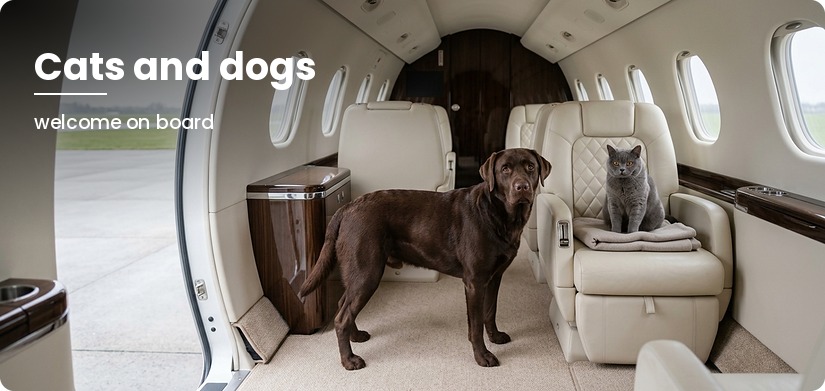
Plan the return first. The operator must be approved to carry animals into Great Britain on that route, and a dog must be treated for tapeworm by a vet between 24 and 120 hours before it lands. Zurich has vets used to the paperwork, and in the ski resorts the local practices know the drill too, but book the appointment when you book the flight. Say that an animal is travelling when you first contact us, so that sectors on aircraft which cannot carry it are filtered out from the start.
Questions about flying private to Zurich
Call +44 7857 574938 , message the same number on WhatsApp , or write to flight@empty-leg.co.uk . Give us the airports, your dates and how flexible they are, and the number of passengers, and we will reply with whatever sectors match together with the full charter price for comparison.
The aviation expert will answer all your questions about business aviation and private flights. We will help you to compare and choose the best business jet for your flight.